Updates on Neuromuscular Disorders

ACE: Advanced Continuing Education
16.00 CE
Medical Credits
On Demand available On Demand through November 2026

Course Overview

Over the past several years, the number and characterization of neuromuscular diseases affecting companion animals has greatly expanded. Neuromuscular diseases can be diagnostic challenges. This course is designed to bring the attendee up to date on the correct approach to the diagnosis of neuromuscular diseases. Classifications of muscle and peripheral nerve diseases have changed, as mutations for genetic diseases are identified and the pathogenesis of these diseases defined. This course will enable recognition of the common clinical phenotypes, understanding of the rationale and need for diagnostic testing, and awareness of new genetic tests. Optimal treatments are still lacking for most neuromuscular diseases. Thus, a well-designed approach to clinical trials is required to aid in the discovery of new and effective therapies. 

Back to the Course Catalog

Who Should Attend

  • ACVIM Diplomates and Candidates
  • European Affiliate member Diplomates and Candidates
  • ACVS Diplomates and Candidates
  • ACVP Diplomates and Candidates
Back to top

Agenda

Learning Objectives

By the end of the course, you will be able to:

  1. Recognize the clinical phenotype of neuromuscular diseases.
  2. Develop a diagnostic strategy including a complete history, physical and neurological examinations, electrodiagnostic testing, imaging studies, and muscle and nerve biopsies.
  3. Understand the indications and use of genetic testing and value to breeding programs.
  4. Develop a therapeutic strategy with the recognition that not all neuromuscular diseases are treatable.
  5. Understand that the clinical findings and diagnostic testing should be evaluated in total to determine a final clinical diagnosis.  
Back to top

Cost

CategoryPrice
ACVIM Diplomate; European Partner Diplomate$750
ACVIM Candidate; European Partner Resident$375
Nonmember Diplomate$1,010
Nonmember Candidate$505
Back to top

Meet the Instructors

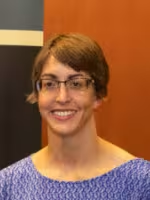
Image
Monica Alema Headshot
Monica Aleman, MVZ Cert., PhD, DACVIM (LAIM, Neurology)
COURSE LEADER
Professor
University of California Davis

Dr. Aleman obtained her veterinary degree at the University UNAM-Mexico. She completed residencies in large animal internal medicine (equine emphasis) and neurology and neurosurgery at UC Davis; and achieved board certification for both specialties by the American College of Veterinary Internal Medicine. Dr. Aleman completed a PhD in comparative pathology in neuromuscular disorders at UC Davis which led to the discovery of a genetic mutation of the ryanodine receptor 1 gene (RyR1) that causes malignant hyperthermia in Quarter Horses. Dr. Aleman is author of over 140 peer reviewed medical publications, over 100 proceedings and abstracts, and over 30 book chapters; and is a regular speaker in national and international continuing education and research meetings. Dr. Aleman was recently appointed the Terry Holliday Presidential Endowed Chair in Comparative Neurology by the University of California at Davis, awarded for neurology research and clinical work by UCD at the American Association of Equine Practitioners (AAEP), and awarded an alumni recognition for Excellence in teaching, research, and service by the National Autonomous University of Mexico.

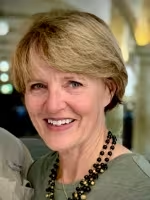
Image
G Diane Shelton headshot
G. Diane Shelton, DVM, PhD, DACVIM (Internal Medicine, Neurology [Hon])
COURSE LEADER
Professor
University of California San Diego

Dr. Shelton graduated from the University of California Davis School of Veterinary Medicine followed by an internship in small animal medicine and surgery at Michigan State University and a residency in small animal internal medicine at the University of Pennsylvania. She returned to UC Davis where she completed a PhD in Comparative Pathology in 1985 and achieved board certification in veterinary internal medicine.  Following graduate studies, she was a post-doctoral fellow from at the Salk Institute for Biological Studies, La Jolla, CA in the laboratory of Dr. Jon Lindstrom, with an emphasis on experimental and naturally occurring models of myasthenia gravis.  In 1990, Dr. Shelton established the Comparative Neuromuscular Laboratory (CNL) in the School of Medicine, University of California, San Diego (UCSD), an international reference center for the study of spontaneously occurring neuromuscular diseases in companion animals. Currently she is Director of the CNL and Professor, Department of Pathology at UCSD. Dr. Shelton has over 300 publications describing muscle and peripheral nerve diseases, and spontaneous animal models of neuromuscular diseases with human correlates. In 2023 Dr. Shelton was honored to have been named a distinguished alumnus of the UC Davis School of Veterinary Medicine and an honorary diplomate of the ACVIM Neurology Specialty. 

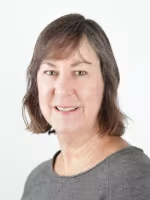
Image
Peter Dickinson
Peter J. Dickinson, BVSc, PhD, DACVIM (Neurology)
Professor Neurology/Neurosurgery
University of California Davis

Dr. Dickinson graduated from Liverpool University Veterinary School in 1989. Following 1 year in mixed general practice he completed a 2 year surgery/anesthesia  internship at Glasgow University Veterinary School. He received his PhD in developmental neuroscience in 1995, also at Glasgow University, before completing a Neurology/Neurosurgery residency at the University of California, Davisin 2000. He is currently Professor of Neurology/Neurosurgery at UC Davis Veterinary School and is a diplomate of the American College of Veterinary Medicine (Neurology). His clinical and research interests include neuroncology and genetic aspects of breed related neurological disease. He has a strong interest in several aspects of neuromuscular medicine, including development of novel diagnostic procedures and diagnostic biomarkers for common neuromuscular disorders.

Image
Steven Friedenberg headshot
Steven Friedenberg, DVM, PhD, DACVECC
Associate Professor
University of Minnesota

Dr. Friedenberg is an Associate Professor in the Department of Veterinary Clinical Sciences at the University of Minnesota. At the University of Minnesota, he is a member of the Canine Genetics Laboratory and the renowned Center for Immunology. He also holds faculty appointments in the Comparative Biomedical Sciences, Veterinary Sciences, and Bioinformatics & Computational Biology graduate programs. Dr. Friedenberg earned a BS in chemistry from Yale University, and graduated from veterinary school at Cornell University. He completed a rotating internship in Small Animal Medicine & Surgery and a residency in Emergency & Critical Care medicine at The Ohio State University. After finishing his residency program, he earned a PhD in genetics at North Carolina State University. His research focuses on studying inherited autoimmune disorders in dogs.

Image
Nicolas Granger headshot
Nicolas Granger, DVM, PhD, DECVN, FHEA, FRCVS
Head of Neurology and Neurosurgery Service
Bristol Veterinary Specialists

Dr. Granger is a veterinary surgeon qualified from the National Veterinary School of Alfort, France (2002), where he completed his European College of Veterinary Neurology training (2006). He then worked as a Lecturer at the Queen’s Veterinary School Hospital, University of Cambridge, where he obtained a PhD in neuroscience (2012). He continued his research and teaching as Senior Lecturer at the University of Bristol up until 2016. He is now head of the neurology & neurosurgery service at Bristol Veterinary Specialists (CVS referrals). His main interest is spinal cord injury in dogs, with a focus on neuromodulation for incontinence control.

Image
Vishal Murthy headshot
Vishal Murthy, DVM, DACVIM (Neurology)
Assistant Professor of Clinical Neurology/Neurosurgery
University of California Davis

Dr. Murthy is an Assistant Professor of Clinical Neurology/Neurosurgery at the University of California, Davis. His clinical and research interests include biomarkers of neural function, bladder dysfunction and barriers to neurology education. He also enjoys using his artistic side to educate through medical illustrations. Originally from Toronto, Canada, Dr. Murthy received his veterinary degree from the Ontario Veterinary College and completed his residency in Neurology and Neurosurgery at the University of California, Davis. In his spare time, he enjoys creating art, cooking elaborate meals, and getting lost in a good book.


Image
Edward “Ned” Patterson headshot
Edward “Ned” Patterson, DVM, PhD, DACVIM (SAIM)
Professor of Small Animal Medicine
University of Minnesota

Dr. Patterson is a Professor of Small Animal Medicine at the University of Minnesota College of Veterinary where he has been on the faculty for 20 years.  He is board certified in small internal medicine and has a once-a-week dog and cat seizure clinic. He has been funded for canine genetics and neurologic/neuromuscular research by the NIH, Animal Foundations, and breed groups, and has published 54 manuscripts regarding canine genetics and neurological and neuromuscular disorders including as a co-author of 9 consensus statements. He was on the organizing committee for the biannual International Conference on Canine and Feline Genetics and Genomics (ICCFGG) from 2013- 2022 including hosting the meeting in St. Paul, MN in 2017.


Image
Stephanie Thomovsky headshot
Stephanie Thomovsky, DVM, MS, DACVIM (Neurology), CCRP, cVMA
Clinical Professor of Neurology and Neurosurgery
Purdue University

Dr. Thomovsky is a Clinical Professor of Neurology and Neurosurgery at Purdue University.  She is also the Director of the Purdue Physical Rehabilitation Department.  She is originally from upstate New York.  She completed her residency in neurology/neurosurgery at the Purdue University in 2010 and since that time has worked in academia, initially at the Washington State University and more recently at Purdue University where she teaches neurology/neurosurgery and physical rehabilitation.  Her research interests are varied but include: physical rehabilitation and the neurologic patient, the hearing and balance and paroxysmal dyskinesias.

Image
Stephanie Valberg
Stephanie Valberg, DVM, PhD, DACVIM (LAIM)
Professor
Michigan State University

Dr. Valberg is an international leader in equine neuromuscular disorders having served as a Professor at the University of Minnesota and an endowed chair at Michigan State University.  She currently directs the muscle biopsy service ValbergNMDL.com. She received her Doctor of Veterinary Medicine from the University of Guelph Ontario Veterinary College and her PhD in equine exercise physiology from the Swedish University of Agricultural Sciences. She is board certified in large animal internal medicine and veterinary sports medicine and rehabilitation. The overarching goal of Valberg’s research and clinical work has been to define the basis for neuromuscular disorders in horses, develop accurate, minimally invasive diagnostic tests, and produce optimal methods for preventing or managing performance limiting diseases. Her research has led to the discovery of numerous muscle disorders. Dr Valberg is the recipient of several honors including delivery of the Milne Lecture at the American Association of Equine Practitioners in 2012 and she was the first woman to be inducted into the Equine Research Hall of Fame.  Dr Valberg received a lifetime Achievement Award from the ACVIM in 2024 and a 2019 Alumni Achievement Award from UC Davis. She has twice received the Pfizer Research Excellence Award. She has over 200 peer reviewed publications.

Image
Colette Williams headshot
Colette Williams, PhD
EDX Consultant

Dr. Williams has over four decades of experience in veterinary electrodiagnostics (EDX). She was fortunate to learn from Terrell Holliday, a founding father of the Neurology/Neurosurgery specialty in veterinary medicine. In addition to performing EDX for the VMTH at UC Davis, Colette provided technical support for the Neuromuscular Disease Lab which processed fresh muscle and nerve tissue from several species, including humans. Her mission is to encourage the use of EDX techniques in veterinary medicine and to raise the quality to that of its human counterpart. Outside interests include diving, dressage and hiking with her deaf Dogo Argentino, Xander.

Back to top

CE Credits

On-Demand Course Registration:  This program has been approved for 16 hours of anytime, non-interactive, seminar/lecture continuing education credit in jurisdictions which recognize AAVSB RACE-approval. 

Back to top